

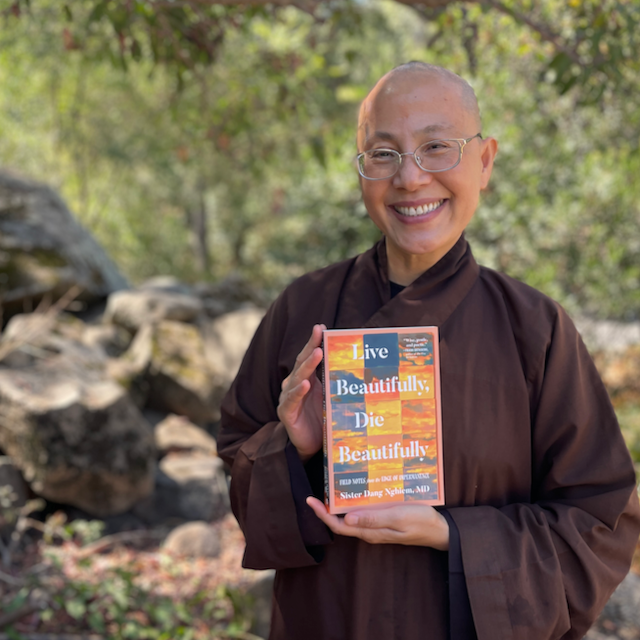
In this article, we share an excerpt from Sister Dang Nghiem’s new book in which she explores the core Zen teaching of the Five Remembrances.
To face death is not only to face the moment the body stops breathing. It is to face the truth of impermanence in each breath, each step, each letting go. Learning to die daily is how we learn to live fully. Through practice we begin to see nothing can be grasped—not our bodies, not our thoughts, not the people we love. When we accept this, we live with a different kind of tenderness, no longer sacrificing our health to make excess money and then sacrificing our money to recuperate our health. When we see death, we see what a waste it is to be so anxious about the future that we can’t enjoy the present. If we stop living as if we will never die, then we will not die without having lived.
One way I practice dying each day is very simple: I keep my space in order. I place the lid back on my cup. I tidy my room and make my bed. Before traveling, I sort through my belongings to see what can be given away. Monastics do this before each three-month winter Rains Retreat. These small acts remind me nothing truly belongs to me; I could leave this body at any moment. When I go to sleep, I expect to wake— but I also know I might not. When I travel, I may or may not return. This awareness is not morbid. It is freeing.
The Buddha taught that among all wholesome deeds, the greatest merit comes from the simple awareness of impermanence. Everything changes. Our joys, our sorrows, our youth, our strength—none of it stays. The earth itself is impermanent. When we forget this, we cling to what has already passed or chase after what has not yet come. When we remember impermanence, we stop waiting for life to begin. We recognize what is available to us right now: our breath, our health, our relationships, our community, our capacity to practice. Gratitude becomes a wellspring of energy and joy.
Many of us focus on our views and ambitions and forget to care for our bodies and minds. When life does not unfold the way we imagined, we collapse into despair and thoughts of worthlessness. We spend so much time fighting outward battles that when we finally turn inward, we feel estranged from ourselves. This is why daily practice matters.
With each breath, we touch the truth of life and death: To breathe in, we must release the out-breath; to breathe out, we must release the in-breath. Each breath is a small life and death. Mindfulness becomes a rehearsal for dying with dignity and without fear—a practice of letting go, of loosening our grasp, of opening the heart. In Buddhism, death is not simply the cessation of respiration. It is also the closing in of craving, fear, or despair. Death, in this deeper sense, is not only the end of the body. It is any moment when we lose the capacity to see clearly, to love, to be kind. Wrong views like craving, fear, and hatred are all forms of dying. Awareness, presence, and understanding are forms of birth.
From Live Beautifully, Die Beautifully, published in 2026 by Parallax Press